Ritu’s Dream on a Narrow Path
Submitted by The Lutheran World Federation
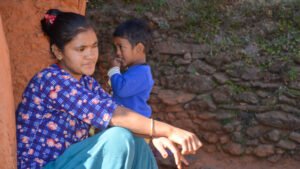
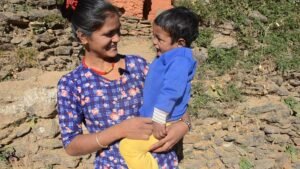
Along a small dirt path in Adarsha Rural Municipality of Doti, 19-year-old Ritu Bohora walks carrying her toddler. She looks like many other young mothers in rural Nepal, but her life story is filled with pain, loss, and quiet courage.
Ritu was only 16 when she was forced to marry.
“I was studying in grade eight,” she says. “I wanted to continue school, but my family said we were poor and my studies were not good. They decided marriage was better.”
Ritu comes from a poor Dalit family from the Haliya (freed bonded laborer) community. Even today, many Haliya families in western Nepal have no land, little income, and few opportunities. Girls are often the first to lose their chance for education.
Because her elder sister could not conceive a child, Ritu was forced to marry her sister’s husband. He was about 12 years older than her.
“I did not understand what was happening,” Ritu says. “Nobody asked me what I wanted.”
After marriage, her husband took Ritu to India, where he worked as a laborer in a factory. Like many men from Sudurpaschim Province, he had migrated because there were no jobs at home.
“We went to India hoping life would become better,” she recalls.
But only six months after their marriage, tragedy struck. Her husband died in a factory accident in India. With no compensation or support, Ritu had to return to Nepal with her husband’s dead body.
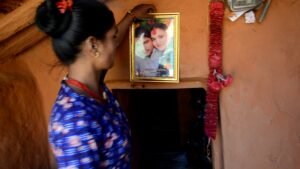
“I came back with nothing except my child,” she says.
Ritu, still a teenager, now lives with her mother-in-law and her small son. Most of her days are spent doing household work.
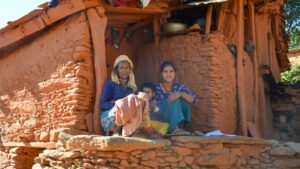
“I am young, but my life feels very heavy,” she says.
Ritu’s story reflects the harsh reality of unsafe migration. Many young men from Haliya and other marginalized communities travel to India for risky and unprotected jobs. When accidents happen, families are left alone to face the consequences.
With support from LWF Nepal and its implementing partner Community Development Center (CDC) Doti, Ritu received help to start goat farming.
“At first, I was scared,” she says. “Now I can earn a little by selling goats.”
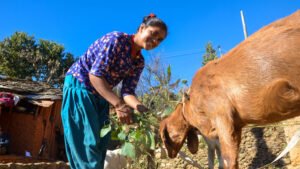
The income helps her buy food and send her son to school.
“I am happy my child can study,” she says. “That gives me hope.”
Ritu still carries a quiet dream.
“I want to study again someday,” she says. “I don’t want my son to live the same hard life as me.”
Ritu’s life shows how poverty, early marriage, caste discrimination, and unsafe migration can trap young girls. But it also shows that with small support and opportunity, a young woman can begin to rebuild her life.
“I cannot change my past,” Ritu says. “But I want a better future for my child.”
Under the Local Initiative for Community Empowerment and Development (LICED) Project, 26,475 people (69% women and 18% persons with disabilities) from 11 districts were directly reached in 2025 through interventions in three areas: livelihoods, quality services, and protection and social cohesion, with support from Australian Aid and Australian Lutheran World Service.